


The hospitality and tourism industry is evolving faster than many traditional education programs. Businesses today need more than employees with strong professional knowledge. They also need people who can handle real-world situations, work effectively in multicultural environments, apply technology, and design distinctive experiences for guests.
This raises an important question: how can education keep pace with the constantly changing demands of the market?
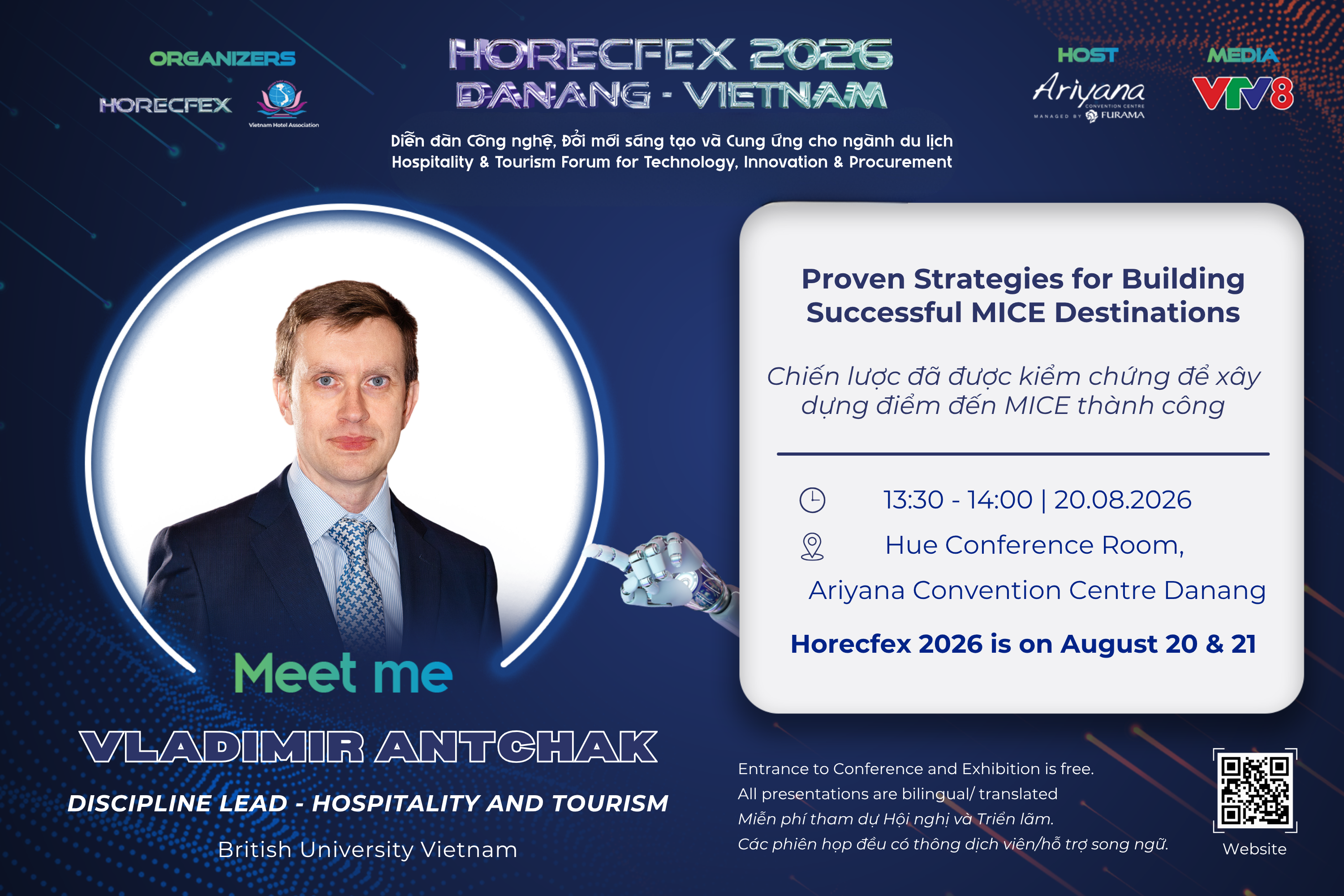
At HORECFEX VIETNAM 2026, Dr. Vladimir Antchak – Head of Tourism and Hospitality Management at British University Vietnam – will bring a perspective that connects education, operational practice, and experience development across the hospitality industry.
Before entering academia, he directly managed numerous international exhibitions and large-scale corporate events in Russia and Europe, including projects for the European Commission and the United Nations Development Programme. This experience showed him that a successful event or tourism product depends on more than effective processes. It also requires a deep understanding of customers, the ability to coordinate resources, and the capacity to create emotion throughout the entire experience journey.
With more than two decades of professional experience across Russia, New Zealand, the United Kingdom, and Vietnam, Dr. Vladimir Antchak has had the opportunity to observe differences between markets, education models, and employers’ expectations of young hospitality professionals.
His session at HORECFEX VIETNAM 2026 will offer insights into how universities and businesses can work more closely together, bring real-world industry situations into the classroom, and equip students with the capabilities the industry genuinely needs.
For hotel managers, tourism businesses, and event organisers, this is also an opportunity to reconsider their own role in developing the next generation of talent. A high-quality workforce cannot be developed in the classroom alone. Businesses need to participate directly through internships, mentoring, real-world projects, and the sharing of professional experience.
In an industry built around people and experiences, education does more than supply talent to the market. It must help students understand the industry, adapt to change, and be ready to create new value from the moment they begin their careers.