


Da Nang, August 20, 2026 – Vietnam's tourism is at a special turning point: visitor numbers are recovering strongly, infrastructure continues to be invested in, and visa policies are becoming increasingly open. However, the question for the new development phase is no longer simply “How many visitors will Vietnam welcome?”, but rather “How long will each tourist stay, how much will they spend, and what value will they receive from Vietnam as a destination?”.
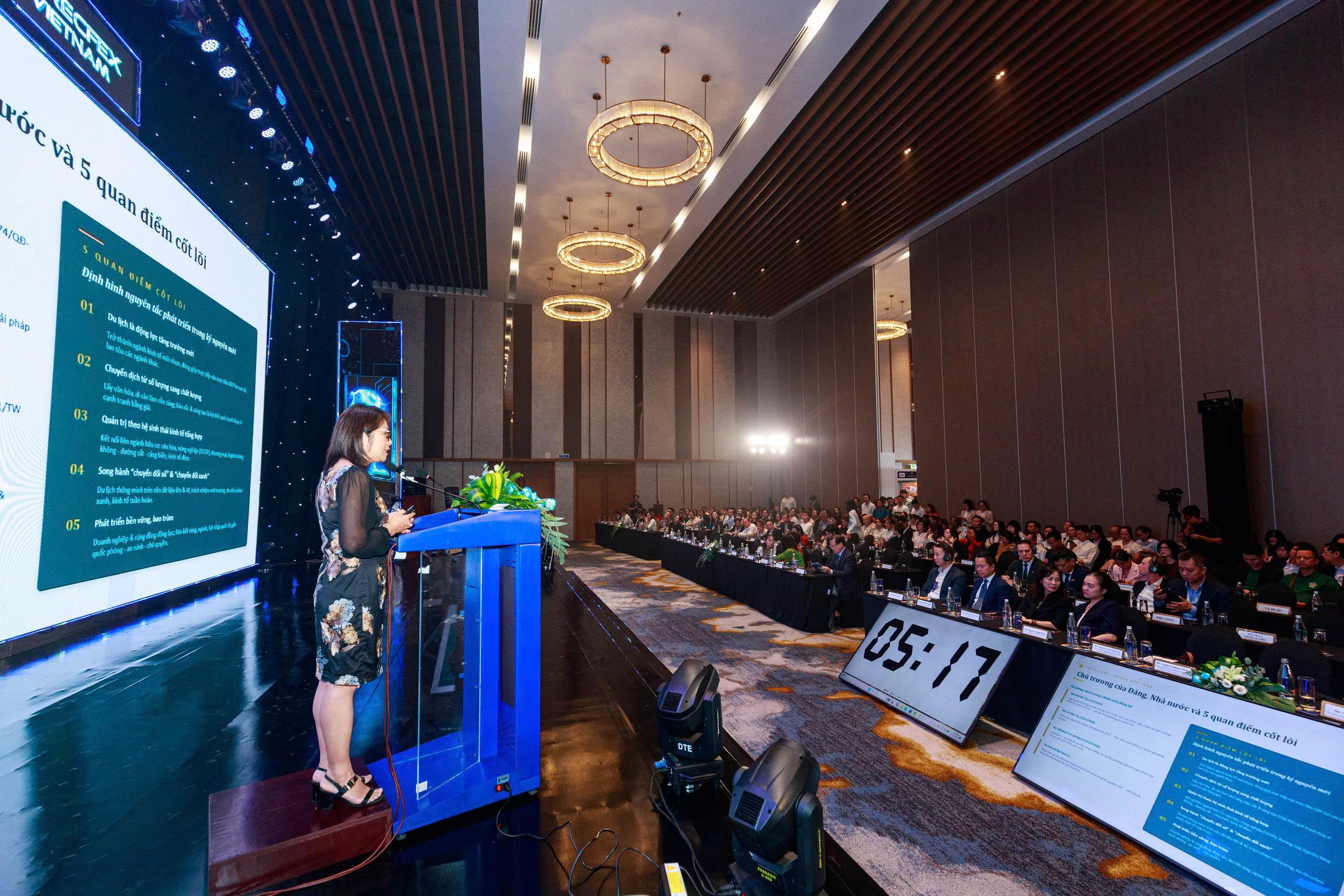
That was also the major issue raised in the opening presentation of the Workshop Session by the Vietnam Hotel Association at HORECFEX Vietnam 2026, which took place on the morning of August 20 in Da Nang.
In the presentation on the development orientation of Vietnam Tourism for the 2026–2030 period, Dr. Do Cam Tho, Head of the Planning and Finance Department of the Vietnam National Authority of Tourism, posed a strategically significant question: Should Vietnam's tourism in the coming years continue to choose growth in quantity or shift strongly towards increasing value?

Rapid growth, but "quantity" and "value" are not yet aligned
Looking at the most recent figures, the immense resilience of Vietnam's tourism is evident.
In 2024, Vietnam welcomed 17.6 million international arrivals and 115 million domestic arrivals, with total tourism revenue reaching approximately 780 trillion VND. In 2025, international arrivals increased to 21.2 million, domestic arrivals reached 137 million, and total revenue hit the 1 quadrillion VND mark.
The upward trend continues in 2026. In the first 7 months of the year, Vietnam welcomed nearly 13.92 million international arrivals, an increase of 13.8% over the same period; domestic visitors reached about 98 million, and total tourism revenue was approximately 675 trillion VND.
But behind those positive numbers lies a thought-provoking issue.
Average spending by international tourists is currently identified at around 1,200–1,400 USD per trip, and domestic tourists at about 2.4–2.6 million VND per trip. Meanwhile, about 70% of the international market share still comes from Northeast Asian markets including China, South Korea, Japan, and Taiwan; high-spending markets such as the Middle East, Northern Europe, North America, Australia, and emerging markets still represent a modest proportion.

In other words, the "quantity" is there, but the "value" has not increased commensurately.
This is perhaps also one of the issues that the hotel industry needs to pay special attention to. Because if the number of visitors increases but the length of stay is short, spending is low, and the destination experience is not rich enough, the pressure on infrastructure and resources will increase faster than the actual value that tourism brings.
Goal of 45–50 million international visitors by 2030
The development orientation sets very ambitious goals.
By 2030, Vietnam aims for 45–50 million international arrivals, 160 million domestic arrivals, and total tourism revenue of 80–90 billion USD, equivalent to about 3.1–3.2 quadrillion VND; accommodation infrastructure reaching about 1.5 million rooms and tourism creating about 5.8 million direct and indirect jobs.
The year 2026 specifically is considered a pivotal year.
The base scenario sets a target of 27 million international arrivals and 153 million domestic arrivals; while the low scenario is 23.2 million international visitors and 148 million domestic visitors. Achieving the goal of 25–27 million international arrivals this year is seen as an important prerequisite for moving towards higher growth scenarios in the 2027–2030 period.
However, it is noteworthy that the high scenario is not simply the scenario with the most visitors.
Among the three development scenarios to 2030, the high scenario is called “Value Breakthrough”, with international visitor growth of 15–18% per year and 45–50 million arrivals by 2030. Accompanying conditions include institutional improvement, development of the night economy, diversification of high-end visitor markets, and especially a breakthrough in spending and the value chain.
This is a notable change in the approach to tourism growth.
From “stimulating quantity” to “stimulating spending”
This transformation is quite evident in the market orientation.
For international visitors, Vietnam will both consolidate traditional Northeast Asian and ASEAN markets and expand depth in Europe, North America, Australia, and markets with high spending power and long stays.
Notably, India, the Gulf Cooperation Council (GCC) countries, the Russian Federation, and the Muslim visitor market are identified as new potential areas that require a systematic approach strategy.

For the domestic market, the mindset is also proposed to shift from “stimulating quantity” to “stimulating spending”.
Instead of just discounting to attract more visitors, products need to target higher-value needs such as 2–3 day weekend getaways, high-end MICE, family vacations, and the night economy.
This is an issue directly related to the hotel industry.
A hotel cannot just sell rooms. A destination cannot just sell plane tickets and scenic spots.
To increase spending, there must be more reasons for guests to stay and more things worth spending money on.
Hotels will have to transform from a “place to stay” into a part of the destination experience
The product orientation for the new phase also shows a broader picture.
Four main product lines including coastal and island tourism, culture-heritage, ecology, and urban tourism will continue to be upgraded. Alongside these are products capable of creating high added value such as wellness and medical tourism, MICE, golf, and shopping tourism.
Data
This places the hotel industry before a major change.
In the old model, hotels mainly provided bedrooms, restaurants, and some amenities.
In the new model, hotels and resorts must become part of an experience ecosystem: gastronomy, culture, wellness, conferences, entertainment, shopping, sports, local experiences, and the night economy.
This is also an opportunity for Vietnam's Hospitality industry to move away from room rate competition.
When a hotel creates more experiences, revenue no longer depends solely on occupancy or ADR, but comes from the guest's entire journey at the destination.
AI, data, and green transformation will change how tourism operates
Another noteworthy point in the 2026–2030 orientation is that digital transformation and green transformation are not seen as two separate programs, but as two parallel pillars.
The orientation sets out the formation of a national tourism data system connecting the Central government, localities, and businesses; the application of AI and big data in destination promotion and management; the development of multilingual virtual tourism assistants; digitization of procedures, electronic tickets, and cashless payments; while simultaneously applying IoT and AI in energy management and environmental monitoring at accommodation facilities and destinations.

For hotel businesses, this means that digital transformation in the coming years will not stop at PMS, booking engines, or chatbots.
Data will increasingly become an asset in revenue management, personalizing experiences, energy management, and understanding customer behavior.
Growth cannot be sustained by just building more rooms and welcoming more guests forever
Currently, Vietnam has more than 40,000 accommodation establishments with about 800,000 rooms, of which 3,510 establishments are rated from 1 to 5 stars.
If the goal for 2030 is about 1.5 million rooms, the question for the hotel industry cannot just be “how many more rooms do we need to build?”
More importantly, it must be:
Who will sleep in those rooms? How many nights will they stay? How much are they willing to pay? And besides the room rate, what other experiences will they spend money on?
That is precisely the intersection between the national tourism strategy and the hotel industry development strategy.